You’ll find all the original posts here, but please see my new blog at CoachDShen.com!
This blog has moved to CoachDShen.com!
Leave a reply
You’ll find all the original posts here, but please see my new blog at CoachDShen.com!
In my last O6:O3 update, I noted that my eating pattern and aggressive supplementation had driven my O6:O3 ratio to 0.7 to 1, resulting in diarrhea and some more stomach upset than normal.
The next 4 months after my last test results, I retained my eating pattern but stopped O3 supplementation almost entirely. I only supplemented when I ate out (5g of O3 at any meal that I ate out), and I would take 2.5g whenever I ate my new favorite snack: organic macadamia nuts, which unfortunately have a high component of O6 in them despite being good for you on many levels.
As the 4 months progressed, I noticed that my stomach distress went away. I did notice that over time, my nose did get a bit more stuffy, whereas before this time I had very little episodes of stuffiness. In previous updates, I noted that I was amazed that my seasonal allergies had literally disappeared during my transition to a <1 to 1 O6 to O3 ratio. However, I find it may not be related to this transition of O6:O3 ratio as global warming has gotten more severe and could throwing more dust and pollen into the air, and I've been riding my kids to school on my cargo bike and spending more time outside huffing and puffing. Still the allergies have not been debilitating as in previous years before manipulating my O6:O3 ratio.
At the end of the 4 months, I tested my O6:O3 ratio again and got 1:1! How interesting that nearly no O3 supplementation, minimizing O6 intake (ie. steaming vegetables, using only organic grass fed/finished beef tallow for cooking oil), and eating only grass fed/finished beef and wild caught fish has resulted in a ratio of 1:1.
I intend to hold my eating and very light supplementation pattern for another 4 months to see if this ratio changes. It was also interesting to note that despite having the same pattern over the previous two cycles, I measured 0.9 to 1 and then 0.7 to 1 four months after. This suggests that potentially the body is still undergoing a transition in ratio, and that maybe 4 months, the estimated time to turn over all the blood cells in a human body, is not accurate in my case and I could be still turning over past that time.
As all who practice Original Strength know, crawling is one of the most fundamental movement patterns we practice and is one of our basic Resets. Babies crawl before they walk; it helps develop their strength in all four limbs and their nervous system to prepare them for standing and walking. However, while babies crawl a lot, they don’t crawl long, continuous periods of time despite spending a lot of time with it. As a prescription, we like to challenge people to crawl 10 minutes continuously which has been shown to have a lot of benefits in strength building and tying your intrinsic cross movement patterns together. But what happens when you crawl more than that?
Earlier this year I embarked on training to crawl the mile. At Original Strength, crawling the mile is legendary; only two other people are known to have done it. The time it took them to do it was about 44 minutes for one and 55 minutes for the other – considerably more time than 10 minutes! So what happens when you perform marathon crawling and crawl A LOT more than 10 minutes?
In the past I raced Ironman and ran marathons, taking swimming, cycling, and running into distances beyond that which you might normally do. During training, I would experience the typical aches, soreness, and the occasional injury. And then there would be the day after when I would be sore and tight due to the previous day’s exertions. Mentally, it was a huge challenge just to keep the body moving for that long, so that long distance was as much mental training as it was physical.
 Me out on the track, building to the mile crawl. |
As I set myself to training to crawl the mile, I braced myself for the same effects as I experienced during my Ironman and marathon training. During the crawling itself, it felt very taxing. In the early months of training, my heart rate would rise and stay maxed out until the very end – a very difficult thing to maintain for such a long time. I would feel tightness in my quads from maintaining the knees up form, and my arms would start to shake towards the end of the crawl as I found out my strength endurance in my upper body was not conditioned to holding my body up for such long periods of time.
However, weirdly, I didn’t feel so wiped out afterwards or the day after. The next morning I would wake up and feel pretty good, despite having an amazingly taxing training workout the day before. Very rarely would I feel anything in my muscles, maybe a touch of soreness in my quads but that was about it.
I also noticed other things.
Normally I train kettlebells during the week. I am currently training for the half bodyweight one arm kettlebell press and have been building weight and volume over the last few months. I also snatched twice a week for 10 to 20 minutes each workout, and am building in both weight and volume there as well. Add to this some bodyweight calisthenics training as warm up and by the end of the week I would often have some aches here or there. Then the weekend would come when I would crawl long. After the crawl and especially the morning after, the aches I would inevitably have from my normal kettlebell and calisthenics training would disappear!
After months of crawling long, I have found that crawling has really supported my kettlebell and calisthenics work. The added conditioning plus its restorative effects on my body have made the snatch sessions feel so much easier and I am not so wiped out after long 20 minute workouts.
Calisthenics work started to progress faster. After I took the Progressive Calisthenics Certification I decided to work on a number of calisthenics movements. One of the toughest is the Human Flag where you suspend yourself via your arms and hold your body out horizontally straight. I was finding that something was lacking in my left shoulder to support myself even for some of the regressions. Through crawling, I found that my ability to take my weight fully onto my arms grew much faster and I achieved my first chamber hold:
I also have found better strength endurance in my upper body, which has helped me build reps in the one arm push up. Similarly, reps in my pistol have risen as well.
How to Begin Marathon Crawling?
There are two basic ways to train for marathon crawling: crawl for time and crawl for distance. If you don’t care about distance, then crawling for time is more than sufficient. You can simply crawl a minute or two longer each time you work out, or you can break up the workout into intervals with rest in between. Before you embark on marathon crawling, I would recommend working up to a good 10 minutes of continuous crawling in the style you choose: baby, leopard, or Spiderman. Note that there is an exponential jump in effort from baby to either leopard or Spiderman, so get used to shorter distances and times first!
I also applied training techniques from my cycling and run training where I would only crawl long once per week but support the crawling mid-week with shorter, interval based workouts. I would also recommend, as with other endurance training, to not increase time or distance more than 10-15% week over week. Expect rebuilds towards your goal, where you hit a wall with increasing linearly time or distance week over week, and you just need to back off and rebuild from a lower time or distance. Supplementing with loaded crawling can have some good benefits, and I would recommend that for your mid-week shorter workouts. You are loading the weekly long crawl enough by going for marathon length time or distance!
While the typical Original Strength goal for crawling is 10 minutes, I would encourage you to try marathon crawling and take your crawling well above 10 minutes to see what effects it has on you. I have found some really great restorative effects in addition to the strength and conditioning you receive. Crawling a mile may not be what you’re looking for, but you can celebrate if you actually get there!
This post originally appeared on the Original Strength blog.
I did a follow up OmegaQuant test and was shocked to find my O6:O3 ratio had continue to move from 0.9:1 to 0.7:1!
I didn’t change my eating or supplementation pattern since my last OmegaQuant test that yielded the 0.9:1. But it was interesting that all that taking of O3 supplements (around 6.3g per day) and removing all that O6 out of my diet (steaming all vegetables, cooking with grass fed beef tallow, no olive oil or other plant based oils) yielded an even stronger O3 showing against O6 in my body.
I asked my researcher friend on what happens if I my ratio goes so far to the other side in favor of O3. Literally no research exists as to what happens to the human body in this condition. I must be a biological anomaly right now in the 21st century; the prevalence of O6 in the typical human diet doesn’t easily allow for a guy like me who is willing to hold a consistent eating and behavior pattern for months.
The only paper he found was this one: Phase I Clinical Study of Fish Oil Fatty Acid Capsules for Patients with Cancer Cachexia: Cancer and Leukemia Group B Study 9473 by C. Patrick Burns, Susan Halabi, et al., Clinical Cancer Research Vol. 5, 3942-3947, December 1999. These researchers gave upwards of 21g of O3 supplements to cancer patients. What was interesting was that they found gastrointestinal distress, like diarrhea, accompanied such large doses of O3 supplements.
This was precisely the symptom I was experiencing more of over the last few months. I noticed that my stomach was having more diarrhea episodes now, whereas before I hit even the 0.9 to 1 I would rarely have diarrhea or even any kind of stomach distress.
Altered fat composition intake and thus fat metabolism? Altered gut bacteria make up? More gut bacteria that processes O3 fatty acids that also causes diarrhea and stomach upset? This all is new and nobody really knows, or has researched it.
Today, I decided to stop all O3 supplementation (except in cases of eating out where I could not control the quality of my food and I would continue my 5g supplementation at every meal where I ate out) and then retest in 4 months to see what changes happened. I think that there is some evidence that 1:1 ratios is best, and I’m betting that if I pull back my ratio closer to that, my GI distress should go away. We shall see.
I recorded this video and never posted it here!
If you’ve been working through my drills to promote diaphragmatic breathing, you’ll want to explore this drill next. Otherwise, you may find yourself capable of breathing diaphragmatically but still find limitations when you try to move or add load and can only generate IAP when you are sitting, standing, or lying down. Time to work it into movement and reap the benefits of using IAP to stabilize versus clamping down with your muscles!
Two weekends ago, I attended the Progressive Calisthenics Instructor Certification (PCC) Workshop at Evolution Trainers in Mountain View, CA. When I heard that the PCC was coming to the SF Bay, I jumped at the chance to learn from the brothers, Al Kavadlo and Danny Kavadlo, who are famous on the internet for their amazing feats of bodyweight strength.
Up to this point, I had been playing with some bodyweight exercises, particularly the push-up, pull-up, and squat. But only in the squat had I made some significant progress towards the one leg version where after years, I could finally drop into a one leg pistol squat on an elevated surface. But the PCC exposed to me much more than just those 3! Certainly I had seen videos of people performing many different feats of bodyweight strength and many crossing into gymnastics. I had some videos and books on the subject but was lacking in some direct instruction. Thus I was looking forward to some live interaction with expert bodyweight coaches.
In the months prior to the PCC, I began to prepare for the certification test, The Century Test, which is completing 100 reps in this manner, within 8 minutes:
| 1. FULL SQUATS: | 40 reps |
| 2. FULL PUSH-UPS: | 30 reps |
| 3. HANGING KNEE RAISES: | 20 reps |
| 4. FULL PULL-UPS: | 10 reps |
This is the men’s test. The women’s test is slightly different.
I basically started with sets of 3 for pairs of the movements. So I picked squats and push-ups for the first pair, and hanging knee raises and pull-ups for the second pair. I would do each pair of exercises once per week until I reached the prerequisite numbers for Century test. Then, I started putting it all together, stringing them one after another. Thus, by the time the PCC came around, I had completed the test 4 times through, and could do it straight through in about 3:40.
PCC Day One: Upper Body
The day started out with fun intros from Al and Danny Kavadlo. They are definitely a fun and engaging pair, and made for an incredibly entertaining workshop.
Today’s exercises focused on the upper body. These were the push-up, pull-up, the flag, and muscle-ups. We went through each exercise in detail, from easy to hard in the progressions. We would be shown an exercise and maybe some variants, and then we were given time to partner up and try them out.
Here’s Al cranking out a perfect one arm pull-up:
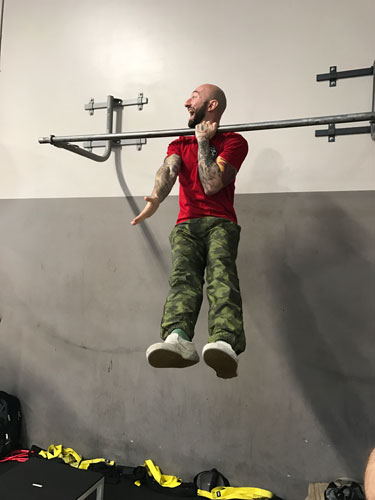
Jealous! Definitely something to work towards.
Here’s me locking out on the muscle up – ha not really – just me locking out a regression to the muscle up:

Yet another one of those elusive moves for me, but now I have a good plan to get there!
In case you were wondering what the human flag is:

At the end, I got them to autograph my copy of Street Workout and they posed with me and the book:

PCC Day Two: Lower Body
The second day saw us working on lower body moves: squats, bridging, ab work, back levers, front levers.
Here’s me knocking out my almost-one leg pistol:
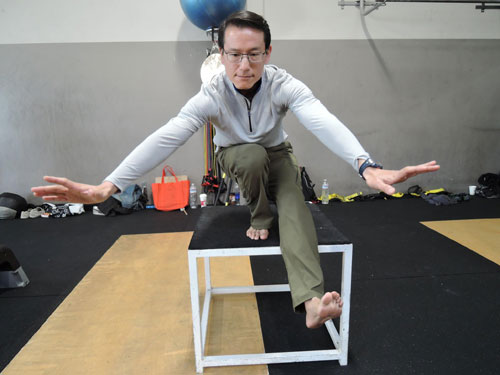
Al and Danny were amazing in their technique. They of course loved to pose for photos – Danny on Al’s bridge:
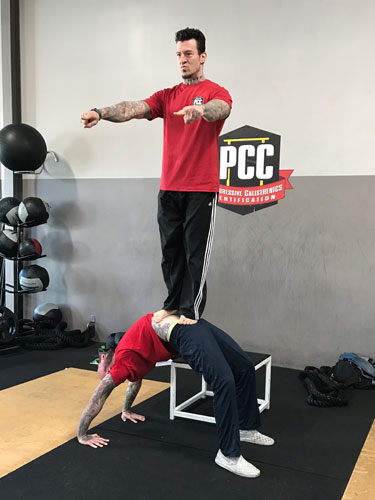
Here is Danny performing the dragon flag:
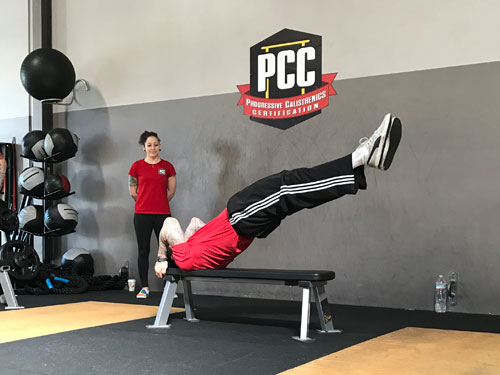
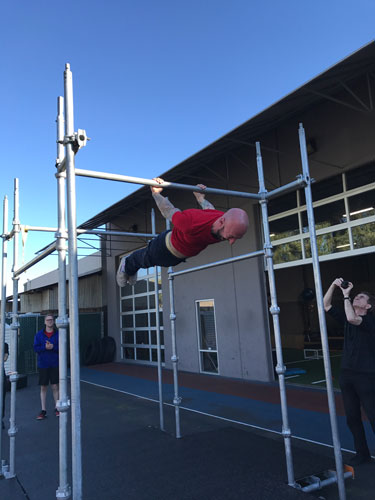
Al and the back lever:
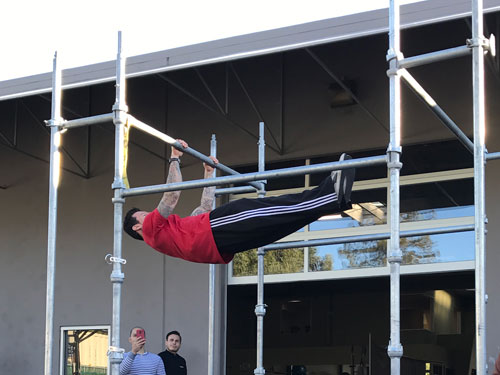
Danny and the front lever:
PCC Day Three: Balance and the Century Test
The third and last day found me kind of sore from the previous two days of work. Today we would concentrate on press levers, head and handstands.
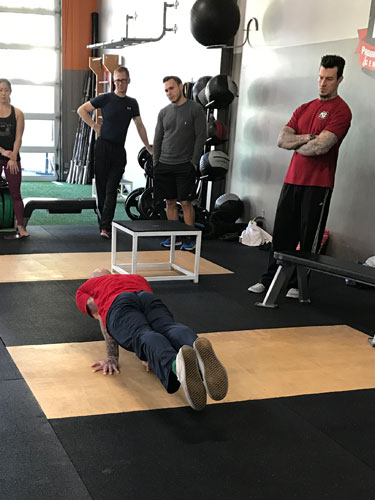
Levers are HARD! But Al makes them look easy:
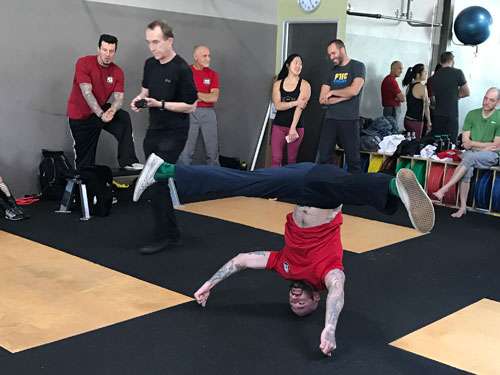
Ready to breakdance anyone? Unfortunately Al would not spin on his head for us:
Here’s Al’s wife Grace Kavadlo breaking out a perfect handstand:

After a light lunch, we were ready to take our Century Test. When it was my turn, I hopped right in. Less than 8 minutes later, I passed and was certified!
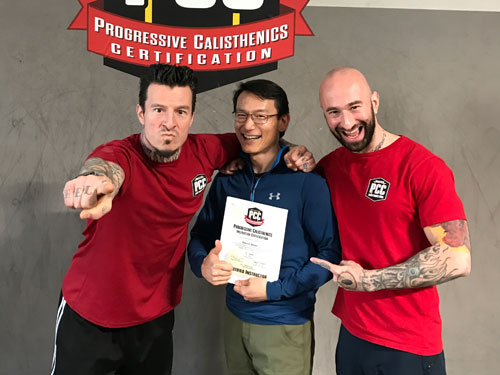
and here we are, the newly minted PCC instructors:
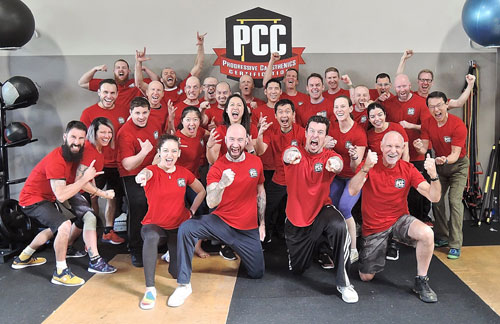
What did I think of the PCC workshop?
1. Al and Danny Kavadlo delivered brilliantly. They were extremely detailed in their teachings and dropped a ton of knowledge bombs. It is clear they’ve been doing this for a long time. They were also very entertaining and provided 3 days of fun.
2. When you work with a coach directly, they can give you a ton of tips and drills to help you achieve the final expression of each movement set. These are often missing from books and videos. Hearing it live always helps.
3. There was ample time to try everything that was taught. I liked their format where we were shown one or two things, then we broke up into pairs to try it out.
4. The PCC Manual is probably greater than 2″ thick! Lots of information to dive into!
5. I personally was glad to have had a bit of one on one instruction with the instructors. I hit a one arm push-up to a 12″ surface for the first time during the weekend.
By the way, the assistant instructors were also most excellent. Super high quality and lots of experience from them as well.
6. The Century Test for me was a dull roar since I had done it 4 times through already. But for many I think they were doing it for the first time. Not knocking anyone here, but I would think that if you paid $1000+ to go to a cert that wouldn’t you train for it so that you can pass there and not later?
I also highly recommend grabbing these books: Convict Conditioning, Convict Conditioning 2, and Raising the Bar, which contain a lot of the instruction found in the PCC. Of course any of the books by Al Kavadlo and Danny Kavadlo are excellent and should be read!
There are also DVDs: Convict Conditioning: Volume 1: Prison Push-Ups; Volume 2: The Ultimate Squat Course (now not in DVD but streaming); Volume 3: Leg Raises; Volume 4: Advanced Bridging; Volume 5: The One Arm Pull-Up Series and Raising the Bar DVD, all companions to the books.
All in all, I felt that the PCC was a fantastic course to take and am very happy to be certified as an instructor. I would highly recommend it if you’re into bodyweight training. I am now in GTG (Grease the Groove) mode with many of these moves and just practicing a bit each day, and hope to build on this over the next few months.
A quick video on the “Finish” where the hand in the water stroking back reaches the end and exits the water:
In March of this year, I met up with some folks working in the area of inflammation and how it relates to every non-communicable disease out there. The concept of the inflammatory model for disease is a new emerging area of study and I’m excited for what comes out of it, which in reality has always been known, but never comprehensively put together nor with treatment protocols created.
The field is very broad but one of the most significant instigators of inflammation in the body is the imbalance of Omega 6 (O6) fatty acids, which is pro-inflammatory in our bodies, versus Omega 3 (O3) fatty acids, which are anti-inflammatory. Both are necessary components in humans and are required for proper body function. However, the Western diet has, over the last century, come to be dominated by O6 due to the proliferation of vegetable oils. Any vegetable oil that you use in cooking, frying, salad dressings – anything – is literally almost all O6 and no O3. Even olive oil, which is great for you by a lot of measures, is still 11 to 1 in ratio of O6 to O3. Check out this Wikipedia page on the ratio of O6 to O3 in typical oils. It also talks about typical ratios of O6 to O3 in other foods as well.
Note that industrial farming has also increased the O6 content of foods. For example, grain fed beef has a lot more O6 in it than O3, when compared to grass fed/grass finished beef. This is seen in other animals and fowls as well.
The average Western human has a ratio as high as 25:1 (O6:O3), with a range of 10 to 20:1, given a diet rich in vegetable oils, fried foods, sugar, and processed carbs. Anthropological studies put ancient humans with a very natural diet at a ratio of 1:1. Some have estimated a healthy range between 2.3 to 1:1.
Two great resources on the topic are:
Omega-6/3 Fatty Acids: Functions, Sustainability Strategies and Perspectives by Fabien De Meester (Editor), Ronald Watson (Editor), Sherma Zibadi (Editor)
and:
Fish, Omega-3 and Human Health by William E.M. Lands
With that in mind, I set out to see what it would take to move my own ratio to 1:1, taking me all the way back to caveman status, and, of course, hopefully lowering my inflammation.
As with any experiment like this, I began with an O6:O3 test. Omegaquant’s blood spot fatty acid tests are perfect for this. You can measure just O3, or do trans fats, or do a full fatty acid profile. You just prick your finger, smear your blood on the card, and mail it in. Results are sent back to you via email. I would change my diet and hold it constant for 4 months; which is about how long it takes for all the blood cells in your body to die and be reborn. When the cells are reborn, you want them to be reborn in a different fatty acid ratio environment.
I used the Omega-3 Index Complete test, pricked my finger, smeared it on the card, and sent it in. This was March 28, 2016. A week later, the results came back with a ratio of 1.6:1 (O6:O3)! I thought I was eating healthy but didn’t think I would have a value that was that close to 1:1.
My diet and eating pattern back then was like this:
Breakfast:
Bulletproof fasting:
Bulletproof coffee with 1 Tbsp Brain Octane
Glass of water with 11g BCAAs, 1 Tbsp MCT oil.
Supplements:
Nordic Naturals Ultimate Omega, 4 capsules = 2560mg O3
Nordic Naturals Ultimate Omega + CoQ10, 2 capsules = 1280mg
Total O3 supplements = 3840mg
Notes:
Supplements were taken in the morning without food.
Lunch:
Hamburger patty, cooked in olive oil, or Salmon mostly, or other fish, cooked in olive oil.
Notes:
Hamburger was either Whole Foods pastured raised or grass fed. Chose either.
Salmon was chiefly Whole Foods Atlantic Salmon, farm raised. Other fish was whatever Whole Foods may have: snapper, sea bass, black cod.
Olive oil is Whole Foods brand organic virgin olive oil.
Stir Fried Vegetables, likely one of: broccoli, snow peas, spinach. Cooked in olive oil.
Dinner:
Rib-Eye or New York Steak or Hamburger. Steak cooked on my NuWave Oven (I’ve had mine for 2 years, so check out more recent models.) Hamburger cooked in olive oil.
Stir Fried Vegetables, likely one of: broccoli, snow peas, spinach. Cooked in olive oil.
White potato or Yam, baked.
Eating Out, Snacking:
While the above was a sample of menu of when I cooked, I probably ate out for lunch often during the week and got takeout with the familiy multiple dinner times. This could be Armadillo Willy’s barbecue brisket, or takeout Chinese. Occasionally it would be seafood from a restaurant. Sometimes I’d eat sweet potato fries to substitute for baked potato or yam. On business trips, it was just eat whatever was out there.
I did snack on Bulletproof chocolate every day (small square or two). I would fly every weekend and eat trail mix in the airports.
Still, pretty good that I reached 1.6:1 eating like that. I thought that moving from 1.6:1 to 1:1 would be fairly straightforward.
For the first phase, I thought I would try to supplement my way to 1:1. In the Omega-6/3 Fatty Acids book, there is talk of needing upwards of 10g of O3 per day to balance out O6 in the typical Western diet. I increased my Nordic Naturals to add another 4 capsules of Ultimate Omega, raising my daily intake in the mornings to 6400mg. Again I would take these all at once in the morning, with no meal. I also added a liquid Nordic Naturals Omega 3 supplement of 1 tsp, which was 1600mg of O3. So now my total was about 8000mg per day. Surely if the book said 10g would take someone on a normal Western omnivorous diet to 1:1, 8000mg on my already great diet should take me there?
I didn’t make any changes to my diet at all.
4 months later, on 8/16/16, I sent in another Omega 3 Complete test and got it back a week later. My O6:O3 ratio was 1.4:1.
With supplementation of 8000mg, it only moved my ratio about .2. In examining what could have been done better, I realized:
1. Somebody pointed out to me that it is not just a game of increasing O3, but also reducing/removing O6. When I examined my diet, I noticed a bunch of things that could be removed. These were:
a. I stopped cooking with olive oil. I bought a steamer and resolved to steam all my vegetables. I also would cook my hamburger with beef tallow from a butcher shop called Belcampo, who sells beef raised on their own farms and are totally grass fed and grass finished. They’ve even tested their beef and found it to be 1:1 O6:O3 ratio! I figure the beef tallow from them must have a good O6:O3 ratio as well.
b. I would buy and eat only grass fed grass finished beef. So I started visiting Belcampo more, and I would only buy the Panorama grass fed grass finished beef at Whole Foods.
c. I decided that for this trial, I would focus solely on wild caught salmon which has the largest amount of O3 in any fish. While by some measures, farmed Atlantic salmon has the highest amount of O3, I decided to stay away from it due to it being farmed.
d. No more snacking on nuts at the airports. While they may provide good nutrients, they are also loaded with O6.
e. No avocados either. Lots of good fats in there, but still lots of O6.
f. As for eating out, there isn’t much I can do there except ask for steamed vegetables whenever possible and staying away from any sauces or dressings. Also I would stop eating any fried foods.
2. I read somewhere that supplementation with O3 doesn’t work as well as eating O3 in foods. Also on the bottle it recommends taking the O3 capsules with meals which is NOT what I did. So I resolved to take them with meals. I also thought about how food is digested and potentially the timing of the doses is necessary, to align especially with meals with higher O6 content so that you can balance it out at that meal’s time. So I broke up my dose into lunch time and dinner time.
I changed my dose to:
With lunch:
Nordic Naturals Ultimate Omega, 2 capsules
Nordic Naturals Ultimate Omega + CoQ10, 2 capsules
Total = 2560mg
With dinner:
Nordic Naturals Ultimate Omega, capsules
Total = 2560mg
If I ate out, I would add an additional 4 capsules at each meal to hopefully throw in a ton of O3 alongside higher levels of O6.
In essence I was reducing the amount of supplementation, except when I’m eating out, and hoping that eliminating any and all sources of extra O6 would bring me back to a better ratio, or hopefully 1:1.
I therefore embarked on the most spartan and most consistent eating pattern I’ve ever done.
4 months later, on December 15, 2016, I sent in another test and the results came back a week later at 0.9:1! I actually overshot 1:1 by .1! Wow!
Some notes:
1. I look forward to the development of more advanced tests to determine inflammation in the body and want to get tested. The traditional test of hsCRP is only for acute inflammation and not chronic low grade inflammation which, hopefully, is lowered for me given my new ratio.
2. I did observe some health effects during this process.
a. Even at 1.6:1, I was suffering from some pretty severe dry eye. As I moved through the year improving my ratio and diet, the dry eye get measurably better. Unfortunately it did not go completely away. There is some research showing good results from treating dry eye with O3 supplementation but it only moved me a little bit and not all the way. I continue my search for dietary interventions to totally cure my dry eye.
b. My seasonal allergies literally went away during this process. I used to have constant allergy problems with nasal drip irritating my passages and throat. It would happen many times during the year. But now, I rarely get them. Allergies are inflammatory problems by nature, and I think the improvement of my ratio and my diet has made a huge improvement here. Despite my great ratio of 1.6:1, I had to move beyond it to see the improvements.
c. My skin is less dry. I used to get a rash on my hands if I didn’t apply moisturizer, after going through some days of normal bathing but also washing the dishes and hand washing. But now it seems much better, or more tolerant of the typical washing that happens.
3. It’s really interesting that at a ratio of 1.6:1 didn’t have me already at a better place with respect to the above issues. However, I think it’s the improvement in diet and removal of stuff I was putting in my mouth, during the exploration of how to get to 1:1, that really made the improvements. At this point, I am not sure it was O6 that was the *sole* problem. There could have been other inflammatory foods I was eating that were causing the problems, or it was a combination of O6 and eating other inflammatory things. These conditions tend to be multi-factorial, and there are a lot of things that could be working in combination to create the conditions.
4. My wife was amazed that I could literally eat the same thing every day without getting sick of it. I think that there is opportunity to use spices to mix things up. I also ended up adding pickles, sauerkraut, and kimchi to add different flavors.
You have to realize that if you care about your health, you’re going to need to stop eating what is out there. It is really making our whole population sick. My parents both died of heart disease because they dutifully followed government and medical recommendations on diet. I remember seeing lots of corn oil, the removal of beef and concentration on eating fish and fowl (fowl is one of the best sources of O6; you can’t buy fowl that is not fed by manufactured feed) which ended up being more fowl than fish. There was no control over eating sugar or sweet things either. I also saw the passing of my father in law from lung cancer; his diet had no controls whatsoever – neither did his smoking. And I’ve also got another relative with severe Type 2 Diabetes. This person has been in the hospital multiple times due to organ failure and has been on dialysis for over a decade. I have seen these things happen in my family and now realize they are totally preventable – you basically just need to stop listening to the government, stop reacting to popular marketing (just to throw two things out there, check out: How Breakfast Became a Thing and how the sugar lobby has worked their way into every health organization in the US.) and even your doctor because all the advice they are going to give you hasn’t done anything for the prevalence of obesity, diabetes, heart disease, cancer – you name it, the incidence of all non-communicable diseases is rising sharply.
Yes, it tastes wonderful. But like all things, you can choose. I chose to give it up because my health is more important to me than needing to experience the sensory excellence of some cooking. And I’ve seen first hand what terrible things can happen to you when you get one of those non-communicable diseases. Time to choose.
Here are my stats from my Omron Body Monitor on Saturday 12-17-16:
| Weight | 139.6 lbs |
| BMI | 21.9 |
| Fat | 13.3% |
| Muscle | 41.6% |
| RM | 1516 |
| Body Age | 28 |
| Visceral Fat | 5 |
Given that I started out around 168 lbs and at 25% body fat early in 2016, this is an amazing result! And I’m only 5’7″ so losing nearly 30 lbs off my already small frame is still astounding, sometimes frightening to me.
Two comments and results:
1. I remember reading Muscle and Fitness magazine when I was in high school and college, and through my 20s. I would lift weights and occasionally I would try to get “ripped” like bodybuilders and go for low body fat and more definition in my muscles. Following those diets never seemed to work. I would carve the fat off all meats, and eat a lot of chicken and salad. I tried eating little to no fat, but didn’t change much with carbs or sugar. I never got “ripped” and would try and give up many times.
Now along comes some more sophistication. I combine CBL with Intermittent Fasting (IF) and am eating fat, and more than I have ever eaten in meals and now I maintain a more “ripped” look daily without any effort.
2. This whole year I’ve been taking blood tests to track a bunch of things. The most interesting change was in my cholesterol.
In January, I saw:
| Total Cholesterol | 342 (High) |
| LDL | 232 (High) |
| HDL | 61 (Good) |
| Triglycerides | 164 (High) |
I was still drinking butter in my coffee along with MCT oil which apparently for some people will raise cholesterol. I had not started CBL at this time.
Across the year, I worked at lowering cholesterol and getting my numbers into better ranges. I stopped butter in my coffee which did lower cholesterol, and tried not eating so much beef for a time which didn’t change my numbers at all.
Recently in November, I saw:
| Total Cholesterol | 174 (Good) |
| LDL | 96 (Good) |
| HDL | 68 (Good) |
| Triglycerides | 50 (Good) |
What a massive movement in all numbers and all for the better!
Granted now people have different viewpoints on cholesterol and its role in predicting disease. My functional medicine doc told me that with high HDL and good LDL particle size, I should not worry so much about cholesterol numbers being so off. But after CBL and changing my body composition to what it is today, I managed to drop all cholesterol numbers into positive ranges.
High triglycerides are associated with high visceral fat. I went from a 7 back earlier this year to a 5 (units unknown) as measured by my Omron. I think losing all that fat between my organs really made a dent in my triglyceride numbers. My current body composition definitely had a large effect on my cholesterol numbers.
Even my normal doc said that I was in his top 5 for those who were able to improve numbers via dietary interventions (Being the competitive guy I am, I replied asking how I could be #1?).
Next on deck is to slowly come off thyroid supplements and see if the improved body composition has also brought my thyroid back online properly.
A friend asked me how I would recommend improving diet and increasing fat loss. Here are my recommendations for someone who is just starting out:
Here is a rather long email on weight loss. Suffice to say that I have tried a number of things and a lot of it is garbage. Note that this includes what a registered dietician or nutritionist will tell you. It is really sad. Here is a list of known prominent health orgs supported by Coke and Pepsi, and their messaging has been manipulated over the years. How can we trust our highest medical organizations with this kind of sponsorship?
First I’ll tell you what I recommend, and then list some resources to read if you feel so inclined.
Tips:
Good luck and let me know if you have questions!